Thursday, May 14, 2015

OPTICS Analysis

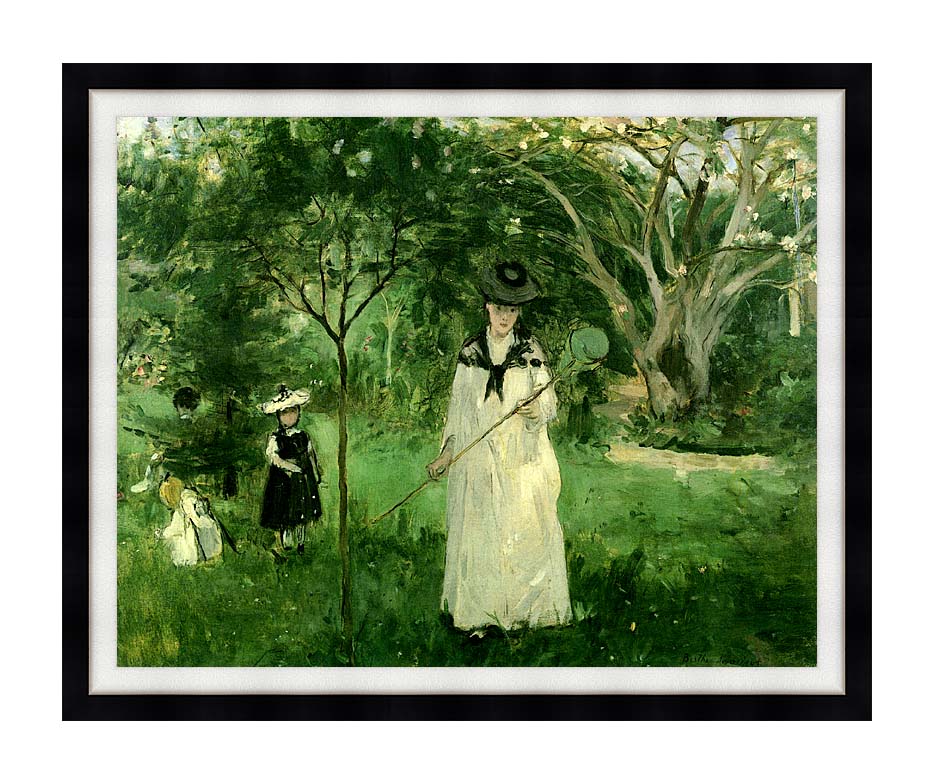
"The Butterfly Chase" by Berthe Morisot, 1874

O: There is a woman standing straight-on holding a butterfly net in the middle of a meadow, as two children explore in search of butterflies. One child stands behind the woman, staring at her.

P: meadow, green grass, trees, long dresses, sunhats, blue skies in background behind the trees, flowers blooming on the trees, woman standing in center, child standing and staring, two children crouched in search of butterflies, woman has an expressionless face, no detail in child's face, vibrant green colors

T: The title, "The Butterfly Chase" conveys the sense of excitement among the children. The woman seems to juxtapose the main feeling of the piece, as she stands motionless in the center amidst the chaos and excitement of trying to catch butterflies.

I: The woman is connected to the children as she is watching over them, though she appears to be apathetic towards the activity, while the children are invested and excited.
The vibrant greenness of the meadow and the blooming of the trees reveals that it is spring or summer, which relates to the four people in the painting as they are taking advantage of this beautiful weather.
The child standing up connects to the woman as she appears to be staring at the woman in a questioning way. It looks as though the child is wondering why the woman does not seem to be enjoying herself as they catch butterflies.

C: This painting ultimately conveys the contrasting feelings of apathy versus fascination. This is revealed through the woman and the children, respectively. While the woman seems wholly disinterested in the activity, participating merely because she is responsible for watching them, the children are fully immersed in the activity.

Friday, February 13, 2015

Hamlet 3.1 - To be or not to be

     In Act 3, Scene 1 of Shakespeare's famous work, the main character, Hamlet, struggles with a moral dilemma regarding whether to live or die. Hamlet questions what is more noble: taking ones life to prevent any further struggles or "to suffer the slings and arrows of outrageous fortune" (III.i.65-66). As he continues, he wonders why one would "bear the whips and scorns of time, th' oppressors wrong...the pangs of despised love" when eliminating such problems through inflicting self harm is a way to escape such struggles (III.i.78-80). Hamlet continues to stress that "conscience does make cowards of us all," which means that man's constant worry about the after life and what will occur after death is foolish (III.i.91). He ultimately believes that it is this fear that prevents man from taking action and making decisions that are right from them, though they may not be right for every individual. 

Wednesday, January 28, 2015

Fate and Free Will Pre-Reading Thoughts

1. Exercising our free will plays an important role in determining our path. Having the ability to express our opinions freely while ignoring the judgement of others is imperative in our development; through our free expression, we develop our personal identity. How we identify ourselves is what dictates the major life choices we make and the path that we find ourselves on. Roger Williams, a historical figure, is a clear example of one who strongly exercises their free will. Williams was banished from the Massachusetts Bay Colony for rejecting Puritanism. Following his banishment, he went on to create a new colony in Rhode Island, where he stressed religious libertarianism. This colony was incredibly successful, and if Williams had not exercised his free will, such religious tolerance may have never been born.
2. I think that to a degree, we are all "actors", especially in an age where social media is such a phenomenon. Honestly, social media is all about perception, and when it comes to perception, we all have an ideal self. We all hope to appear bigger or greater than what we are; Instagram, for example, is a way that people show what is going on in their life. However, someone is only going to post the moments they want people to see. They are only posting the highlights of their life, so that we all get an incorrect representation of exactly who someone might be. While it obviously makes sense that one would only want to post their highlights, this creates a false sense of identity because we live in a time where people are identified through their Instagram, Twitter, and Facebook accounts, rather than who they actually are as a person.
3. I don't think that revenge is justifiable. I've always been taught to "keep my side of the street clean", and I think that is an important idea to uphold. I personally would never want to seek revenge on someone simply because that is what I have been taught. Considering hypothetical situations can make the answer to this question more difficult, though. If you consider a familial situation where, for example, a child in the family has been threatened, many would believe that the parents of this child have a right to revenge. Yet I think that in this age, it makes far more sense to rely on the justice system rather than seeking revenge. In terms of suicide, I think it is very difficult to say whether it is completely justifiable or unjustifiable. However, I come to find that it is entirely up to the person considering it. It's so easy for someone to say that when someone else commits suicide they are being selfish and rash, but at the same time, it is impossible for this person to truly understand what the other person is going through. Some people commit suicide because living has become unbearable; after years and years of dealing with a mental illness, spending every day suffering, they find that it is the only way to truly alleviate their pain. I don't think it's right to say that suicide is unjustified because many people have problems beyond our understanding that are unable to be solved. While suicide should absolutely be a last resort, sometimes it is the only answer for someone that has lived a life full of suffering.
4. In my opinion, madness can be defined in different ways. It could be defined by irregular or chaotic behaviors, which can often times be attributed to a mental disorder. It can have many different contexts, but society, specifically, tends to hold mental illness in a very negative light. To this day, there is still unfortunately a stigma around such illnesses. Madness can also be defined as the questioning of authority. By this, I mean that someone who questions the ideas of those in a position of power may be labeled as "mad." Even still, a label of insanity can be used as an instrument of power. Going back to my example from above, Roger Williams was most likely labeled insane by many, yet it was this questioning that allowed him to become more powerful and begin his own society.

Sunday, November 30, 2014

The Rime of the Ancient Mariner

     In The Rime of the Ancient Mariner by Samuel Taylor Coleridge, an old sailor recounts his experiences at sea to an unsuspecting wedding-guest. He explains how he wrongly killed an Albatross, detailing the many problems that ensued at the hands of nature. Coleridge emphasizes the importance of respecting nature, as it ultimately holds power over man, through the use of literary devices such as personification and religious allusions. 
     Instances in which Coleridge utilizes personification strengthen his idea the nature must be respected, so as to avoid its damage and destruction. For example, as the mariner tells his story to the wedding-guest, he recalls how sheets of ice seemed to overtake the ocean: “it cracked and growled, and roared and howled, like noises in a swound!” (Coleridge 2). By adding that the ice did things such as growl and roar, Coleridge develops a sense of power among this seemingly harmless and stationary force of nature. Personifying the ice, which takes place in the beginning of the poem as the mariner first begins to recount his experiences, creates a sense of equality between man and nature. It even seems to present the ice as having authority over man. Additionally, wind is personified later on in the mariner’s story, as he says “it mangled strangely with my fears” (Coleridge 7). Here, a force of nature is once again given a sense of power and authority, as in this instance, the wind seems to terrorize the mariner, mangling “strangely with [his] fears”.  Personification ultimately reveals the capabilities of nature to wreak havoc and cause destruction, which further presents the idea that it deserves respect from man.
     Coleridge emphasizes this point through the use of religious allusions, as well. These allusions are used to purify nature and question how one could ever possibly harm it, specifically regarding the killing of the Albatross by the mariner. For example, as the Albatross is first seen flying overhead the sailors, the mariner says “as if it had been a Christian soul, we hailed it in God’s name” (Coleridge 2). Comparing the Albatross to a “Christian soul” highlights it’s purity, which therefore criminalizes the mariner further as it remains unbeknownst to all why he would kill such an innocent creature. A religious allusion to God is also employed by Coleridge at the end of the poem as the mariner leaves the wedding-guest, in which he says “He prayeth best, who loveth best all things both great and small; for the dear God who loveth us, He made and loveth all” (Coleridge 9). The mariner communicates this upon exiting to emphasize the importance of treating things in nature with respect, as God created all things to be equal. The mariner does not want the wedding-guest to make the same mistakes that he made, therefore repeating “he prayeth best, who loveth best” to strengthen his points, as he believes God will reward those who treat the nature and its inhabitants with love and respect.
     Through the use of literary devices such as personification and religious allusions, Coleridge portrays his idea that nature must be respected as it is incredibly powerful and can control man.

Monday, November 24, 2014

Unit Essential Questions

1. I think that humans tend to react to isolation very differently. In some cases, they may react adversely, desiring social contact with others. Continual isolation may eventually cause one to recede into it and learn to accept it. Instead of changing their current situation, some people may simply embrace it. Over time, this could lead to negative effects in which the isolated person is cut off from society and human contact. I think that humans need interactions with others in order to be stable, so being completely cut off from society in isolation would prove to be extremely damaging. Yet at the same time, many people desire isolation, for a limited time, at least. For instance, in the novel Into the Wild by John Krakauer, the main character Chris McCandless goes into isolation in the woods in order to free himself from the constraints of society. In my own life, I actually enjoy being alone and undisturbed. However, after too much time elapses, I once again get either lost in my own thoughts, or simply bored, and want to spend time with other people. How humans react to isolation depends entirely on that person.
2. Individuals need human interaction to feel human. These interactions and relationships with others often lead one to feel validated and loved. In Psychology class, however, we recently learned about a case study involving a young girl named Genie, who was kept alone in a room for thirteen years of her life. The only time she was exposed to other people was when her parents left food for her or yelled at her, so Genie essentially had little to no human interaction for this first part of her life. It caused tremendous damage to Genie, which, although an extreme example, displays the incredibly negative effects on a person who lacks human interaction, and therefore, does not feel human.
3. When we don't take responsibility for our actions, we can damage our relationships with others. If someone makes a rash decision that also concerns someone else, it can be equally damaging to both people, whether they are the person who made the bad decision or simply the person who is indirectly involved. Then, by not owning up to our actions, this can lead to even further conflict. It's important that we follow through with what we say through our actions and take responsibility, so as to avoid dragging others into situations that originally they were not a part of.
4. Lack of compassion or understanding leads to prejudice and stereotyping because the person who lacks compassion fails to see things from others' perspectives, and therefore makes generalizations or assumptions based on their preconceived ideas. For instance, as we discussed quite a bit while reading Twelfth Night, there are still many problems regarding gender inequalities in today's society. Women still tend to be viewed as weaker and less able than men, which is a stereotype that has been present for centuries. While there clearly has been a great amount of progress made, it is still an issue that cannot go unnoticed.

Tuesday, November 18, 2014

Twelfth Night Act 4 Response

     While 4.3 of Twelfth Night may at first appear insignificant due to its short length, it is very important as it builds suspense and ultimately contributes to the theme of misunderstanding that is so prevalent throughout the play. In this scene, Sebastian ponders how lucky he is to have come into contact with someone like Olivia, recognizing that neither of them are insane. Olivia professes her love for Cesario, who is actually Sebastian, by asking for marriage, saying "Plight me the full assurance of your faith" (IV.iii. 27). Such a statement produces suspense for the reader, as it would be assumed that Olivia will soon discover who both Sebastian and Viola truly are. Sebastian happily agrees, though he is still confused as to how he found himself in such a situation. He does not want to reveal this confusion to Olivia, however, as he believes that "this accident and flood of fortune so far exceed all instance" (IV.iii. 11-12). Though Sebastian recognizes that there is much more to the situation that he does not know about, he is so pleased with the possibility of a relationship with Olivia  and is satisfied with this "flood of fortune" that he ignores any concern he may have about the situation. This scene also contains dramatic irony; Olivia and Sebastian happily plan to marry each other, but Sebastian's true identity is unbeknownst to Olivia while the audience is aware that drama will soon unfold and true identities will be revealed. Because it strengthens themes present throughout the play, such as misunderstanding, and also builds suspense, Act 4 Scene 3 of Twelfth Night is a necessary part of the play.

Thursday, November 13, 2014

Are Shakespeare's messages about gender still necessary for society to consider today?

     Throughout his work, Twelfth Night, Shakespeare stresses that stereotypes regarding gender hold no validity, ultimately deeming them inaccurate. Yet in today's society, such stereotypes still exist. Even in this day and age, women are viewed as fragile, while men are considered more strong and powerful. I think it is important that we consider Shakespeare's messages about gender so that we can come closer to eliminating these stereotypes. Though considerable progress has been made over the years, I believe that our society still has a long way to go in regards to gender expectations.
     In the second act of Twelfth Night, Orsino and Viola--disguised as Cesario-- discuss the love between men and women. Orsino claims that "there is no woman's sides/Can bide the beating of so strong a passion/As love doth give my heart; no woman's heart/So big, to hold so much; they lack retention" (II.iv.103-106). However, Viola soon retorts that "In faith, they are as true of heart as we" (II.iv.117). She later adds that "We men may say more, swear more, but indeed/Our shows are more than will; for still we prove/Much in our vows but little in our love" (II.iv.128-130). By suggesting that men do not follow through with their commitments in regards to love, Viola challenges Orsino's idea that men are full of passion that women are unable to match. Here, Viola displays her disagreements with such stereotypes that Orsino mentions. This goes on to contribute to Shakespeare's ideas that these stereotypes are invalid as Viola outwardly disagrees with someone who holds power over her.
     In the "Shakespeare Gender Swap!" clip we watched today, those who conducted the experiment changed the name of of certain Shakespeare characters so that readers believed they were the opposite sex. All of the information and details about the character remained the same, with the only difference being the gender. Readers described the female character as "immoral, manipulative, and weak," while the exact same character as a man was described as "brave, smart, and lustful." I think that this says a lot about how society views women in comparison to men. Even with the exact same actions, the female version of the character is considered flawed while the male version is superior. This clip highlighted that people today still have different gender expectations.
     Though stereotypes are still prevalent today in many ways, there certainly has been a great amount of progress. I recently saw a video about a campaign by "Always", challenging the use of the phrase "Like a Girl" in an insulting context. In the video, a few young women in their late teens are asked to, for instance, give there best impression of what it means to "run like a girl". All of these older girls ran clumsily with their arms waving around, clearly fulfilling the interpretation that many of us have of this phrase. However, much younger girls, around ages 6-10, where asked to do the same thing. When asked to "run like a girl", these girls ran powerfully, pumping their arms and taking long strides. This commercial seeks to eliminate the degrading connotation that the phrase "like a girl" has. When someone says that another person does something like a girl, this generally means that they do it poorly or that they are weak, yet this association between girls and weakness is inaccurate. In truth, this phrase should have absolutely no negative connotation whatsoever, as doing something "like a girl" should not be any less powerful.
     It is still incredibly important to consider Shakespeare's ideas about gender in our society today, because while progress is being made, stereotypes still exist, with both women and men being generalized and viewed a certain way.


Tuesday, November 4, 2014

SPOTTTS Analysis: "Diving into the Wreck"

S: Self-exploration and discovery
P: The diver organizes their equipment and prepares to dive alone.
As they are about to begin their descent, they reflect on the ladder and its' innocence.
They descend down the ladder and adapt to their new environment, unsure of where the ocean will begin.
At first, the diver feels out of control as they experience the ocean, but soon realizes that they have the power to successfully complete this dive.
The diver acknowledges how easy it is to forget their purpose in this new sea environment.
Recounting their original purpose, the diver explains their goal to explore this underwater wreck and any treasures that may be hidden.
The diver is filled with a new sense of motivation, as they desire to experience the wreck, rather than simply read about it.
The diver details the beauty and mysteriousness of the wreck by creating the mermaid and merman, both of which are figments of their imagination and make them feel powerful.
Exploring the wreck, the diver discovers those who lost their lives, their belongings rotting in the wreck.
The diver explains human curiosity and their desire to revisit the wreck, as they are drawn to it even though it may not concern them directly.
O: The occasion of the poem is a diver exploring a shipwreck in the ocean, possibly seeking self fulfillment or personal growth.
T: The title "Diving into the Wreck" sets up the reader for what the poem will be about, giving them an indication of the events that will take place. The wreck may serve as a symbol for personal struggles or difficulties.
T: The tone of this poem is captivating, contemplative, and determined.
T: The speaker suggests that while both self-reflecting and having new experiences can be frightening, such as this descent into the ocean, they are necessary in order to achieve growth or gain new understandings as individuals in order to overcome struggles.
S: The speaker is a diver who utilizes stream of consciousness to reveal her thoughts and ideas.


Tuesday, October 28, 2014

The Awakening Criticism Response

     I agree with the argument presented in Yaeger’s critical essay on The Awakening, as Edna never truly liberates herself from man. Throughout the novel, she strives to free herself from the constraints of her husband, Léonce. While she is successful at liberating herself from Léonce, man continues to have power over her for the duration of the novel. 
     In Yaeger’s essay, she asserts that after she is “freed from the repressive talk of her husband, Edna chooses another mode of oppression, a speech-world that offers space for flirtation that Edna finds liberating” (Yaeger 287). Edna has an incorrect definition of liberation; she does not emancipate herself but instead thrusts herself even deeper into the role of a stereotypical damsel in distress, “as if romance were the only form of elation a heroine might feel” (Yaeger 286). She relies on Robert, who, unbeknownst to her, exerts force over her and hinders her progress towards her empowerment.
     Her relationship with Robert in the second part of the novel completely discredits the idea of being free, as she looks to him as a means to make her happy and feel whole. Yet by having Edna rely on Robert, Chopin contradicts the character’s original desires to question the conventions of society and stand alone. Instead, she becomes increasingly dependent on Robert, though she views this dependency as liberation.
     Even the referral to Alcée’s hand as “magnetic” (Chopin 125) supports the idea that Edna is rendered powerless by man, engulfed by passion and her desire for physical attention. When Robert leaves her one night, she continually asks “you will wait for me?” (Chopin 147), which highlights her increasing dependency on him as she is afraid of being alone. Though Edna succeeds in liberating herself from her husband, the novel is contradictory in the sense that this “liberation” is accompanied by a growing sense of dependency.

Sunday, October 26, 2014

The Awakening Ch 31-39

      "Every step she took toward relieving herself from obligations added to her strength and expansion as an individual. She began to look with her own eyes; to see and to apprehend the deeper undercurrents of life. No longer was she content to "feed upon opinion" when her own soul had invited her" (Chopin 127).
     Through this statement, Chopin emphasizes the importance of developing a personal identity free from the influence of others. Such an idea is highlighted through Edna's self-reflective happiness when she begins to "look with her own eyes", specifically by defying Leonce and moving into her new home. She no longer conforms to societal expectations that do not agree with her own. By ignoring the obligations of others and focusing on herself, Edna allows herself a high level of personal growth and development. Chopin ultimately asserts that if one wants to change their life in their own best interest, they must be willing to put themselves first and challenge those who hold power over them.

     "Now you are here and we shall love each other, my Robert. We shall be everything to each other. Nothing else in the world is of any consequence. I must go to my friend; but you will wait for me? No matter how late; you will wait for me, Robert?" (Chopin 147).
     Through the inclusion of this statement by Edna, Chopin illuminates the idea that Edna is rendered powerless by man, no matter what. Although she has grown as an individual and has relentlessly attempted to rebel against the conventions of society, and more specifically, man, she has ultimately failed. Freeing herself from Leonce's oppression may have been a large step for Edna, yet Robert leaves her unable to stand alone and be independent. Repeatedly asking "you will wait for me?"and lying awake all night in despair over Robert, Edna has not truly liberated herself. Chopin addresses the idea that women can never truly be independent by including this statement.

     "All along the white beach, up and down, there was no living thing in sight. A bird with a broken wing was beating the air above, reeling, fluttering, circling disabled down, down to the water" (Chopin 156).
     Chopin utilizes the image of an injured bird to characterize Edna's inability to free herself from the power of man. The bird represents Edna, herself, at the end of the novel, as she accepts her defeat and surrenders herself to the ocean, committing suicide. Connecting to Mlle Reisz's statement earlier in the novel that a bird must have strong wings to "soar above the level plain of tradition and prejudice", Chopin mentions the bird once again so as to mark the end of Edna's spiritual awakening. "Beating the air above", this represents Edna's continual, failed attempts to overcome societies conventions. Edna was never truly able to achieve success because she never became independent from man; though she ultimately left Leonce, her dependency on Robert overshadowed her original act of defiance.


Thursday, October 23, 2014

The Awakening Ch 21-30

     "'Oh! dear no!' said Edna, with a blank look in her eyes. 'What should I do if he stayed home? We wouldn't have anything to say to each other.'" (Chopin 93).
     Here, Edna responds to Adele's idea that she and her husband would have a better relationship if he spent more time at home. "With a blank look in her eyes", Edna disagrees overwhelmingly. Such a response emphasizes not only the faults present in their relationship, such as their lack of communication, but also Edna's unwillingness to make any effort to improve it. Edna is simply finished trying to please her husband or enhance their relationship, as she finally follows her own ideas rather than conforming to the expectations of others. Before, Edna would settle by telling Adele what she wants to hear. Now, she is unafraid to act on her desires and innermost feelings, confessing her contrasting opinions and resistance to improve her relationship with an exclamation.

     "There was nothing which so quieted the turmoil of Edna's senses as a visit to Mademoiselle Reisz. It was then, in the presence of that personality which was offensive to her, that the woman, by her divine art, seemed to reach Edna's spirit and set it free" (Chopin 106).
     Mademoiselle Reisz's music leaves a lasting impression on Edna. Each time Mlle Reisz plays piano for her, she is brought to tears. The "turmoil" is the emotions that Edna keeps inside of herself; though she has developed drastically throughout the course of the novel and has become more vocal about her opinions, some feelings are still trapped inside, such as her true feelings for Robert. Though Edna recognizes Mlle's personality is "offensive to her", her "divine art" has the power of releasing Edna's spirit. It is also Mlle's playing which inspires Edna to follow her own passion of painting.

     "'The bird that would soar above the level plain of tradition and prejudice must have strong wings. It is a sad spectacle to see the weaklings bruised, exhausted, fluttering back to earth'" (Chopin 112).
     This statement by Mlle Reisz serves as a warning for Edna, as the bird is a representation for Edna and her challenging of beliefs. While she has made extreme progress in breaking through the constraints of society, Mlle acknowledges that she must continue to have "strong wings" and stand by her values. However, though she strives to defy the conventions of society, Mlle also warns her that she must avoid becoming "exhausted", as it is possible that she can get too ahead of herself in her rebellion against Leonce and Creole society, which in turn, will lead to her ruin. This statement also may be an indication of a future event. While Edna may be successful in her rebellion currently, Mlle foreshadows that if Edna acts carelessly, she will reap major consequences.
   

Tuesday, October 21, 2014

The Awakening Ch 11-20

     "'I mean to stay out here. I don't wish to go in, and I don't intend to. Don't speak to me like that again; I shall not answer you'" (Chopin 42).
     Here, Edna defies the orders of Léonce for the first time, standing her ground when Léonce tells her to come inside off of the hammock. However, this is not just a small act of defiance; it is one that represents Edna's personal growth and newly acquired ability to stand up for herself. This act of rebellion is incredibly important to Edna's character development as it reveals the beginning of a shift in her expression and the way she carries herself. She no longer submissively accepts her inferiority, but instead embraces her unconventional ideas and acts on them.

     "Edna felt as if she were being borne away from some anchorage which had held her fast, whose chains had been loosening- had snapped the night before when the mystic spirit was abroad, leaving her free to drift whithersoever she chose to set her sails" (Chopin 46).
     Edna is on her way to the Cheniere Caminada, and her "being borne away from some anchorage" symbolizes her growing confidence and longing to surpass the boundaries which have restrained women in Creole society. She is eager to question these ideas, reaching a place where she is "free to drift whithersoever she chose to set her sails". Finally, Edna withholds the the ability to act on her emotions. Rather than restraining her opinions and grievances as an internal affair, she now possesses the ability to more outwardly expresses her beliefs to the point that she even feels her "chains had been loosening". The water represents her awakening and self growth, and by traveling across the bay, Edna's continual development and dynamic attributes are highlighted.
   
     "The Ratignolles understood each other perfectly. If ever the fusion of two human beings into one has been accomplished on this sphere it was surely in their union" (Chopin 75).
     The Ratignolles serve as a major foil to the Pontelliers. Their relationships contrast each other greatly, as the Pontelliers severely lack any sense of understanding. The Ratignolles, on the other hand, represent a model family in Creole society. Understanding each other "perfectly", there is no tension present in their relationship. This is most likely in part due to the fact that Adele is submissive, follows the orders of her husband, and would not dare do anything that challenges his superiority. Therefore, the most prominent differences can be attributed to the fact that Edna refuses to be what is assumed to be a model wife. Instead, she desires liberation and the ability to express herself, even if it means that her relationship is in turmoil.

The Awakening Ch 1-10

     "'You are burnt beyond recognition,' he added, looking at his wife as one looks at a valuable piece of personal property which has suffered some damage" ( Chopin 3).
     By utilizing a simile which compares Edna to a piece of "personal property", Chopin emphasizes the ever-present idea during this time period that women are nothing more than mere objects. Rather than having true concern for his wife, Mr. Pontellier appears to be ashamed. This is because he believes that his wife's actions are a direct reflection of himself, which further supports the societal norm that man has power over woman because women during this period were intended to act as compliments their husbands.

     "She did not sit there inwardly upbraiding her husband, lamenting at Fate, which had directed her footsteps to the path which they had taken. She was just having a good cry all to herself" (Chopin 8).
     Here, Edna feels sorrow over the oppression she is faced with, yet it is nothing more than "a good cry". This conveys the idea that she has accepted her inferiority, and is aware that there is nothing she can do to change how others perceive her in society, specifically her husband. She silently accepts the mistreatment by Mr. Pontellier, which connects on a larger scale to the majority of women during this time. It would be extremely rare that a woman question her husband, instead welcoming his superiority and taking time only in secrecy to deal with grief.

     "Their absence was a sort of relief, though she did not admit this, even to herself. It seemed to free her of a responsibility which she had blindly assumed and for which Fate had not fitted her" (Chopin 25).
     Edna is drastically different from what society believes a mother and wife should be. She secretly views taking care of her children as a chore, and finds their absences to be a "relief". She had never intended for a life like this; her role is one she has "blindly assumed", and it is one in which she had no choice. This once again solidifies the role of women in society, while beginning to reveal the unconventional ways of the character of Edna because she seems to play a limited role in the lives of her sons.

Thursday, October 2, 2014

Happy Endings Structural/Stylistic Elements

Textual Evidence
Structural/Stylistic Element
“They buy a charming house. Real estate values go up” (1).
Short sentences
“The children turn out well” (1).
Declarative sentence
“This other John will emerge like a butterfly from a cocoon, a Jack from a box, a pit from a prune” (1).
Simile
“Mary is hurt” (1).
Simple sentence
“...continues as in A” (2).
Repetition
“She sleeps with him even though she’s not in love with him” (2).
Complex sentence
“Madge, after a suitable period of mourning, marries an understanding man called Fred and everything continues as in A, but under different names” (2).
Periodic sentence
“If you think this is all too bourgeois, make John a revolutionary and Mary a counterespionage agent and see how far that gets you” (3).
Loose sentence
“Don’t be deluded by any other endings, they’re all fake, either deliberately fake, with malicious intent to deceive, or just motivated by excessive optimism if not by downright sentimentality” (3).
Imperative sentence
“So much for endings” (3).
Telegraphic sentence

Wednesday, October 1, 2014

The Ones Who Walk Away from Omelas

     In "The Ones Who Walk Away from Omelas", Ursula Le Guin tells the story of a seemingly perfect society. Such a utopia is only possible, however, because a malnourished child is kept in a small, locked room with no windows. With symbolism, setting, and situational irony, Le Guin sets forth the necessity that immoral ideas be challenged by members of society, even in one that is ostensibly perfect.
     Le Guin begins the story by describing Omelas as a joyous and ideal place in which the citizens are all happy, mature, intelligent, and certainly not naive. By describing the setting, Le Guin creates a supposedly perfect society and aims to eliminate any ideas that it contains underlying flaws. Yet the flute player seems to symbolize isolation, as Le Guin describes him playing alone, ignored by onlookers. This is included to potentially foreshadow the later revealed flaw in the society, as at all other points, citizens are always together, valuing solidarity. Le Guin goes on to say "One thing I know there is none of in Omelas is guilt" (3). Following this statement, it would not be expected that the information about the child is revealed, because clearly this provides citizens with a great amount of remorse and feelings of guilt. Yet even with this knowledge, the citizens still remain in Omelas and live happily. However, Le Guin chooses to detail the unexpected decision of a select few citizens who challenge the ideas on Omelas and leave, to "a place even less imaginable to most of us than the city of happiness". With their decision to leave and find an alternate happiness, Le Guin emphasizes the importance of abandonment to escape a truthfully corrupt society.

Monday, September 29, 2014

Hills Like White Elephants

     In "Hills Like White Elephants", Ernest Hemingway tells the story of a man and a girl struggling to come to an agreement regarding an important decision that needs to be made. Through the use of literary devices, Hemingway characterizes the relationship between the characters as one that is crippled by their lack of communication and their constant misunderstanding.
     Multiple symbols appear in the story, which contribute to Hemingway's interpretation of the characters. The man and girl are unable to come make a decision, which is supposedly whether or not to terminate their child. The man seems to push his ideas on the girl, but then tries to appear indifferent by saying it is ultimately up to her. Yet the entire story, they still constantly avoid addressing the central issue. This is in part symbolized by Hemingway's decision to name the girl "Jig". A jig is a dance, but also could reference a jigsaw puzzle, which can be very challenging and often times unable to decipher or complete. Additionally, the reference to the elephant also represents their avoidance of the true problem. This is damaging to the characters' relationship because they both passively deal with the issue, even though the decision will be an incredibly life changing one. The setting also helps develop the relationship between the characters, as the story takes place at a train station in Spain, overlooking a field of hills. By speaking about the scenery, saying things about the hills such as "they look like white elephants", the girl once again fails to address the issue and tries to distract the conversation by focusing on her surroundings instead (475). Taking place at a train station, the man and girl can either get on or stay behind, which is utilized to represent their growing sense of separation and misunderstanding. With literary devices, Hemingway highlights the relationship between the man and girl, which is based off of poor communication skills and misunderstanding.

Tuesday, September 23, 2014

I Stand Here Ironing

    In "I Stand Here Ironing", Tillie Olsen tells the story of a young and inexperienced woman struggling to raise her children. Olsen utilizes a stream of consciousness point of view, unorganized construction, and a remorseful tone to illuminate the narrator' feelings of regret regarding her performance as a mother.
     Told in the first person perspective, the story includes the narrator's every thought as she reflects on the damaging upbringing of her first born child, Emily. For example, as the narrator details what she does when she hears Emily stirring at night, she includes "(as if she would let me hold her and comfort her like I do the others)" (268). With this stream of consciousness point of view, Olsen emphasizes the extreme feelings of guilt that consume the narrator, as her thoughts of regret are continuous throughout the entirety of the story. Similar to the stream of consciousness point of view, the story is constructed in an unorganized manner, which lends to Olsen's goal of portraying the narrator as a regretful, and nearly frantic, mother. With both simple and complex sentences, containing information completely unrelated to the previous topic, Olsen highlights the narrators worry and feeling of responsibility for Emily's struggles. Finally, the remorseful tone seen in the story characterizes the narrator's views on her performance as a mother as it presents the narrator has extremely guilt-filled. Such feelings of remorse are exposed when the narrator reflects on the relationship between Emily and Susan, explaining that "I have edged away from it, that poisonous feeling between them, that terrible balance of hurts and needs I had to do between the two, and did so badly, those earlier years" (269). Olsen includes thoughts of the narrator which clearly illustrate her regret and feeling of accountability. Olsen's employment of the stream of consciousness point of view, unorganized construction, and a remorseful tone contributes to the narrator's regretful feelings regarding her performance as a mother.

Ribald

Ribald- offensive in speech or gesture

Sunday, September 21, 2014

Cathedral Questions

1. The first-person narrator of "Cathedral" reveals himself as a sarcastic, judgmental, and ignorant man with an incredibly monotonous tone. His comments are filled with sarcasm and lend to his snarky attitude, saying things such as "maybe I could take him bowling", when talking about the blind man (1081). He is possessive and envious as well, reluctantly acknowledging his wife's first husband. Refraining from using his name, he says, "why should he have a name? he was the childhood sweetheart, and what more does he want?" (1080). The narrator attempts to mask this side of his personality by trying to appear indifferent to nearly everything. Instead, it more clearly reveals his bitterness and inability to let go of the past.
2. The narrator sets the reader up for meeting the blind man by continuously stating how much he is dreading the encounter. He has no true reasons to dislike the blind man, Robert, and when both the narrator and readers meet him, things such as the firm hand squeeze and his genuine excitement display that he is a very warm man. While the narrator is not impressed by Robert's demeanor, I believe that Robert is much friendlier than the narrator has continuously claimed. The narrator is clearly jealous of the friendship that he has had with the narrator's wife. The conversation between the two men reveal Robert's apparent vulnerability, because due to his blindness he is unable to detect things such as the narrator's body language and facial expressions, which potentially provide an indication into his feelings.
3. Blindness is addressed in "Cathedral" in a multitude of ways. It is not only present in the story through the character of Robert. The narrator also seems to be blind on a figurative level. He is incredibly ignorant, and it is this ignorance that clouds his perceptions and prevents him from being able to understand and relate to others, such as Robert. All of the different ways blindness is addressed in the story, both figuratively and literally, ultimately contribute to the narrator's inability to see things for what they are.
5. Carver withholds this information to keep readers from knowing whether or not the narrator was actually deeply affected by this epiphany, if at all. It seems as though the narrator has finally found a deeper understanding of himself and the world, beyond feelings of bitterness and envy. Yet judging by the narrator's demeanor throughout the course of the story, it would be difficult for this one moment to influence a character such as him so profoundly. This information is withheld to represent that the narrator is probably still an unchanged man.
6. Carver judges the habits of the narrator and his wife by including so many details about their lackluster relationship. Their relationship is not one based on communication, as during dinner the narrator explains "We didn't talk. We ate" (1084). They have no conversations about anything other than drugs or the narrator's complaints about Robert, and they certainly do not seem happy together. The narrator appears insecure about the relationship, reflecting on his wife's first marriage constantly. I do not believe that the relationship is one based off of love or understanding, as it should be, but I do not judge them because every two people have a different dynamic and definition of what a relationship is.

Thursday, September 18, 2014

Where Are You Going, Where Have You Been?

     In her short story “Where Are You Going, Where Have You Been?”, Oates details the experiences of a fifteen year old girl who is not supported by her family, leading to her desire to be rebellious, and eventually, a run in with an incredibly dangerous man. Oates utilizes extensive descriptions of Connie’s thoughts and actions to develop her character and overall, explore the idea that there is a major danger posed toward young adults who lack familial support and a sense of validation.

     Oates describes Connie as an incredibly rebellious teenager, spending her time daydreaming and checking her appearance. Her mother berates her for her self obsession, constantly exclaiming things such as “‘Stop gawking at yourself, who are you? You think you’re so pretty?’” (468). She also compares her to her sister, June, and is never accepting of the fact that Connie is nothing like her. It drives Connie to wish that her mother were dead. Being put down so often ultimately contributes to Connie’s rebellion and lack of self respect. By including how profoundly affected Connie is by her mother, Oates explores Connie’s reasoning for defying her family. When one lacks validation and support, they are more likely to take risks an act without thinking of consequences. Oates’ decision to develop the character of Connie’s father as an absent figure in her life also lends to the idea that many negatives arise when one is not supported. Fathers will often protect their child in any way possible, and since Connie’s father is almost always away, or unwilling to interact, Connie is lost and forced to save herself when targeted by Friend, a situation that could have been prevented. While coming into contact with a psychopath such as Arnold Friend is a very extreme scenario, it effectively illuminates the idea that familial support and love is absolutely necessary.